

 Holiday Planner
 Absence Management
 Performance Management
 Staff Management
 Document Management
 Training Management
 Pay and Benefits
 Reporting
 Health and Safety Management
 Task Management
 Security Centre
 Self Service
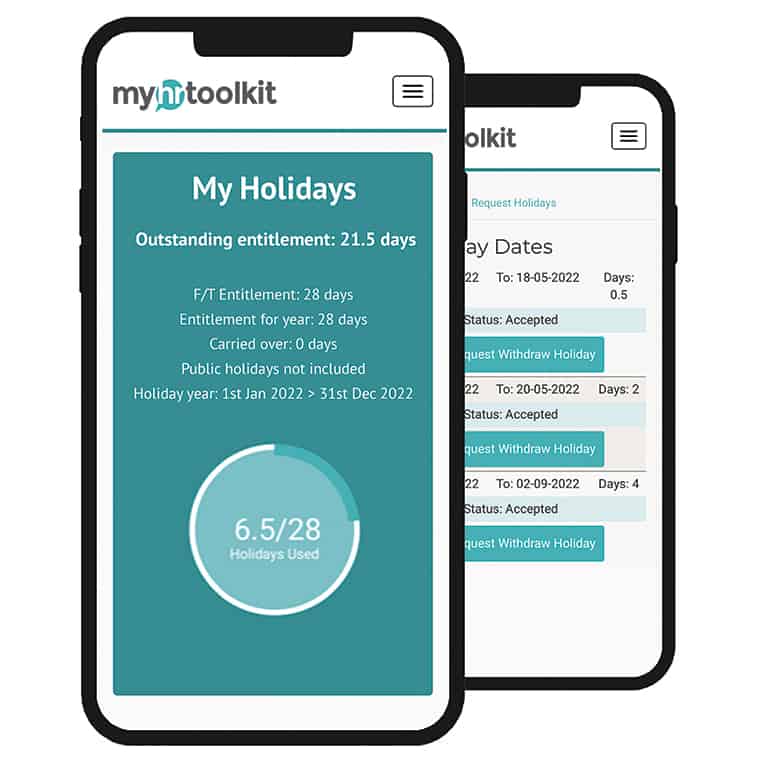 Mobile

Getting holiday entitlement right isn't just about compliance – it's about demonstrating that you value your employees' work-life balance and wellbeing from the moment they join your organisation.
Understanding how to calculate holiday entitlement for new employees is essential for maintaining compliance, ensuring fairness, and creating a transparent workplace culture. With recent updates to UK employment law and evolving expectations around employee wellbeing, getting this right from day one is more important than ever.
Statutory holiday entitlement: the foundation
Under the Working Time Regulations 1998 (WTR 1998), almost all workers are entitled to 5.6 weeks of paid annual leave per leave year. For someone working five days a week, this equals 28 days.
Importantly:
- No statutory entitlement exceeds 28 days, even for those working more than five days weekly
- There's no minimum service requirement - new starters accrue holiday from day one
- This applies to employees, workers, and many on zero-hours or casual contracts
New starters: pro rata entitlement
When someone joins partway through the holiday year, their entitlement is calculated pro rata based on the portion of the leave year they will work as per the Working Time Regulations.
For regular full-time and part-time staff
Example calculations:
- A full-time employee entitled to 28 days per year, joining halfway through the leave year, would receive 14 days
- For part-time employees, calculate entitlement based on their working pattern, then pro-rate again if joining mid-year
Leave year structure
Employers can define their leave year in contracts or handbooks. If unspecified, the default is:
- For employees hired before 1 October 1998: leave year starts on 1 October
- For those hired after: leave year begins on the employment start date
In the first year of employment, statutory leave accrues pro rata and is commonly calculated as 1/12 of the annual entitlement for each completed month. When converting fractional days use a clear, documented rounding policy (for example rounding to the nearest half day) and ensure the policy does not systematically reduce entitlement.
Irregular-hours and part-year workers: the 12.07% method
For staff whose hours vary significantly or who only work part of the year (such as term-time, seasonal, or zero-hours workers), holiday is accrued rather than given upfront.
Key changes from April 2024
For leave years starting from 1 April 2024 onwards, employers must use the 12.07% accrual system for:
- Irregular-hours workers (where hours often or always change)
- Part-year workers (seasonal, term-time, etc.)
- Casual and zero-hours contract workers
How the 12.07% method works
- For every hour worked, 12.07% is accrued as holiday entitlement
- This percentage is based on the statutory minimum of 5.6 weeks (12.07% = 5.6 weeks ÷ 46.4 working weeks)
- Employers should round entitlement to the nearest half-hour (30 minutes or more rounds up, less than 30 minutes rounds down)
- If a worker's contract provides more than statutory minimum holiday, the percentage must be adjusted accordingly
Rolled-up holiday pay option
Employers of irregular-hours or part-year workers may choose to use rolled-up holiday pay, where holiday pay is added to each payslip as an additional payment.
Requirements for rolled-up holiday pay:
- Must be calculated at a rate of at least 12.07% of the worker's total pay in each pay period
- Must be paid at the same time as regular wages
- Must be shown separately on payslips
- Workers must still be encouraged and able to take actual time off
This approach can provide clarity for workers with unpredictable schedules but must be managed carefully to maintain wellbeing and compliance.
Bank Holidays: inclusion or addition?
Employers have flexibility regarding bank holidays:
- May be included within the 5.6 weeks' statutory entitlement
- May be offered as additional paid or unpaid leave
- The key requirement is clarity and consistency - policies should make it clear how bank holidays are treated
What matters most is that the arrangement is clearly communicated in employment contracts and applied fairly across all staff types.
Holiday accrual during leave
Employees continue to build holiday entitlement while on various types of statutory leave, including, but not limited to:
- Maternity, paternity, adoption, or shared parental leave
- Sickness absence
Government tools and resources
The UK Government provides an online holiday entitlement calculator that includes functionality for:
- Part-time workers
- Casual and zero-hours contracts
- Irregular hours
- First and final years of employment
Legal updates and compliance considerations
Recent changes (2024 onwards)
While there were no direct changes to statutory holiday entitlement rates, broader employment law updates have included:
- Reintroduction of the mandatory 12.07% method for irregular-hours workers
- Introduction of rolled-up holiday pay options
- Clarifications on holiday pay calculations for non-standard contracts
- Increased minimum and living wage rates
- More flexible parental leave arrangements
Carry-over rules
Workers can normally carry over:
- Maximum of 8 days into the next leave year (with employer agreement) for those with 28 days' entitlement
- Up to 28 days for irregular-hours or part-year workers
- Additional untaken leave beyond statutory minimum (at employer's discretion)
Best practice for employers
Clear communication
- Be transparent: Communicate holiday entitlement and accrual rules clearly to new starters in contracts and induction materials
- Provide examples: Show how calculations work for different scenarios relevant to your workforce
Reliable systems
- Use trusted HR software: Holiday accrual for irregular-hours staff can be complex, so invest in reliable calculation systems
- Regular monitoring: Track accrual and usage accurately from day one
- Government tools: Utilise the official calculator for verification
Supporting employee wellbeing
- Encourage leave-taking: Beyond legal compliance, actively support staff to take time off for improved wellbeing, productivity, and retention
- Prevent leave hoarding: Proactively manage leave to discourage burnout
- Flexibility: Consider greater flexibility in leave arrangements, especially for remote and hybrid workers
Digital innovation
Modern HR systems are increasingly being used to:
- Automate entitlement tracking and approvals
- Provide self-service leave management for employees
- Generate accurate reports for compliance purposes
- Send proactive reminders about unused leave
Calculate annual leave and update entitlements easily with holiday management software

Calculate annual leave and update entitlements easily with holiday management software
Key takeaways
Holiday entitlement is both a legal right and a vital component of employee wellbeing. For new starters, the foundation of a positive employment relationship includes:
- Fair calculation of entitlement from day one
- Clear explanation of how their specific situation is handled
- Accurate tracking throughout their employment
- Proactive support to ensure they can actually take their entitled leave
Getting holiday entitlement right isn't just about compliance – it's about demonstrating that you value your employees' work-life balance and wellbeing from the moment they join your organisation.
This guide reflects UK employment law as of 2025. Always consult current legislation or seek professional advice for specific situations, particularly for complex working arrangements or when implementing new policies.
More from the myhrtoolkit blog




Written by Fiona Sanderson
Fiona is Marketing Manager at myhrtoolkit. Her areas of expertise include HR systems, productivity, employment law updates, and creating HR infographics.


